


Trusted by 100,000+ patients around the USA









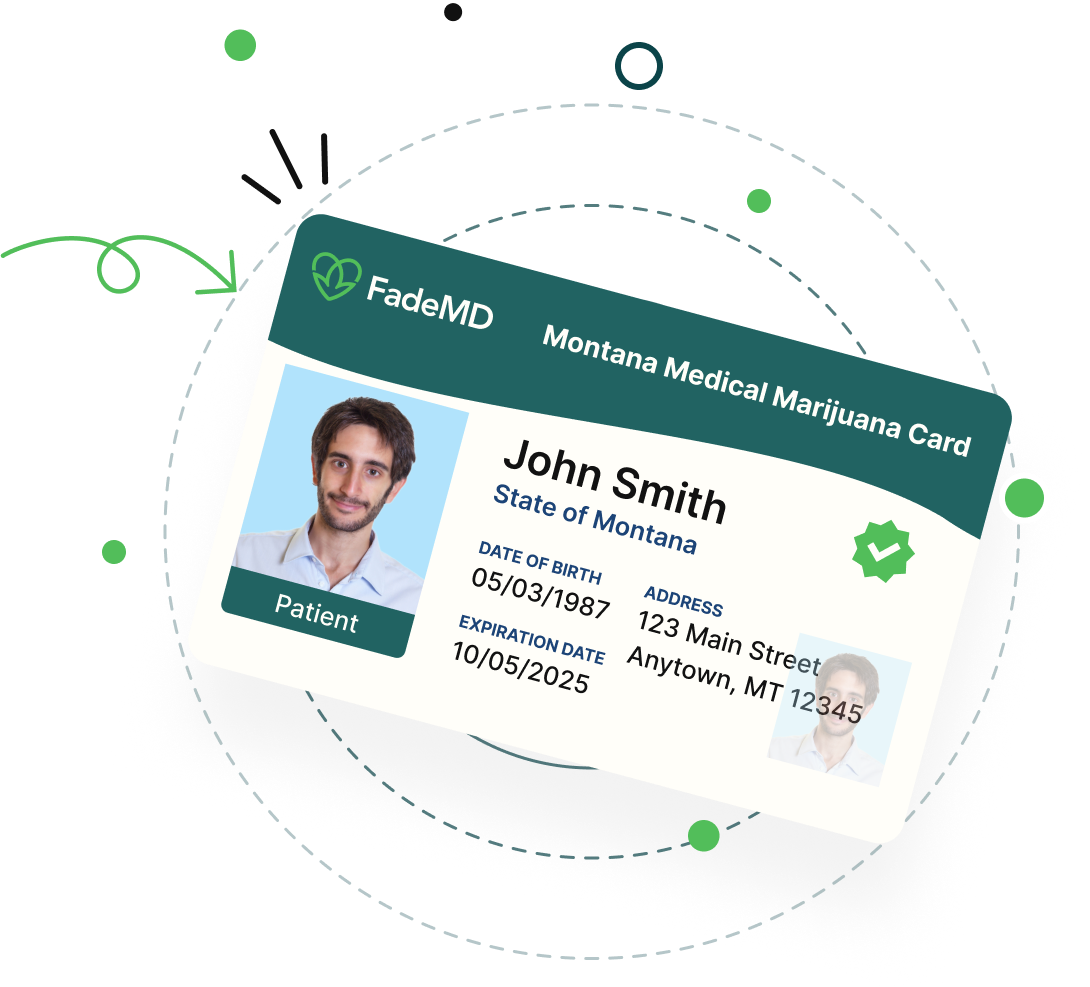
FadeMD simplifies the process of getting a medical marijuana card in your State. Register and speak with a medical professional today.

A licensed medical professionals will review your application and provide a cannabis consultation.

Upon approval, your medical professional will follow State guidelines to certify you for your medical marijuana card.

Receive full dispensary access, renewal reminders, and ongoing treatment options from your provider.


%201.svg)




Medical patients can be 18 years or older for dispensary access.

Medical users have access to better quality and higher strength products.

Save around 16% on medical marijuana taxes in Montana.

A medical marijuana card offers enhanced legal protections in Montana.


FadeMD is the leader in matching patients with medical marijuana professionals. Read patient experiences with FadeMD here.


Montana’s medical cannabis program dates back to 2004 when voters initiated the ballot measure, with 62% approving it.
In the November 2020 election, Montana legalized recreational marijuana for adults 21 and over through two ballot initiatives, I-190 and CI-118. CI-118 amended the Montana Constitution to set 21 as the legal age for purchasing recreational cannabis, while I-190 established rules for its use, including a 20% tax and allowing local opt-out for dispensaries. The Department of Revenue will oversee the cannabis market, and the initiative allows for the resentencing or expungement of past cannabis offenses.
Montana’s medical cannabis program includes a list of qualifying conditions for eligibility. Physician consultations can be conducted via telemedicine, and curbside delivery is allowed.
The tax revenue from recreational cannabis is planned to benefit various programs over the next five years. According to the Independent Record, 10.5% of the revenue will go to the state’s general fund, with the remainder funding conservation programs, substance abuse treatment, veterans' services, healthcare costs, and localities where marijuana is sold.
Montana has come up with a long list of qualifying conditions that include:
Additionally, the state deems that a chronic medical condition or its treatment that causes other symptoms or disorders also makes patients eligible for the medical cannabis program. Those additional conditions and symptoms include:
Lastly, painful peripheral neuropathy, central nervous system disorder, post-traumatic stress disorder (PTSD), or terminal illness also qualify patients for the program.
Along with having a condition, any Montana resident applying for a medical cannabis card must prove their residency with a valid driver’s license or state ID. A Montana medical cannabis card’s cost is $20, and it costs $10 to replace or update provider information.
The Montana medical cannabis program application is straightforward. All prospective patients must be at least 18-years-old and have at least one of the qualifying medical conditions. Additionally, applicants must show proof of residency with a valid copy of a state driver’s license or identification card, or Montana Tribal card. After proving their residence, a patient must provide the state of Montana with a signed statement from the treating physician for a debilitating condition and the medical provider’s name and address. If the Department of Public Health and Human Services (DPHHS) denies a patient’s application, Montana gives residents a second chance to apply. All applications for annual renewal must be submitted within 30 days of the medical cannabis card expiration date.
Like a patient, a caregiver must prove they are a Montana resident, supplying a valid driver’s license or state ID card with their current address. Additionally, a caregiver must not have a felony conviction to legally assist a patient.
To renew your Montana medical marijuana card through FadeMD, you’ll need to schedule a renewal appointment with one of our physicians. They can confirm that you still need medical cannabis for your qualifying condition and help you with the renewal process. We will remind you when it’s almost time for your renewal appointment, or you can reach out to our Customer Service Department so we can assist you and apply a renewal discount for you.
A medical marijuana card in Montana is valid for one year.
Montana updated its possession and cultivation laws in 2017, allowing a registered card holder to have 1 ounce of usable marijuana at a time. Additionally, patients who do not list a provider may cultivate up to four flowering plants and have 12 seedlings. If a cardholder does list a medical cannabis provider, they cannot cultivate their own cannabis.
The Justice Department proposed a new rule to reclassify marijuana as a Schedule III drug, which would ease federal restrictions on cannabis if approved. This reclassification would not legalize or decriminalize marijuana nationwide but would place it on the same regulatory level as ketamine and anabolic steroids. Currently, marijuana is classified as a Schedule I drug, meaning it has "no currently accepted medical use and a high potential for abuse." The proposed change would recognize marijuana as having "a moderate to low potential for physical and psychological dependence."
The proposal initiates a months-long comment and administrative period before any changes take effect. This follows President Biden's 2022 request for the Department of Health and Human Services (HHS) and the Justice Department to review marijuana's classification. HHS found credible scientific evidence supporting marijuana's medical use. The notice of proposed rulemaking reflects the attorney general's agreement with HHS's recommendation. President Biden hailed the move as "monumental," emphasizing marijuana policy as a priority of his administration, which has also worked to pardon those convicted of simple possession.


Our customer support team is on standby to help you out.