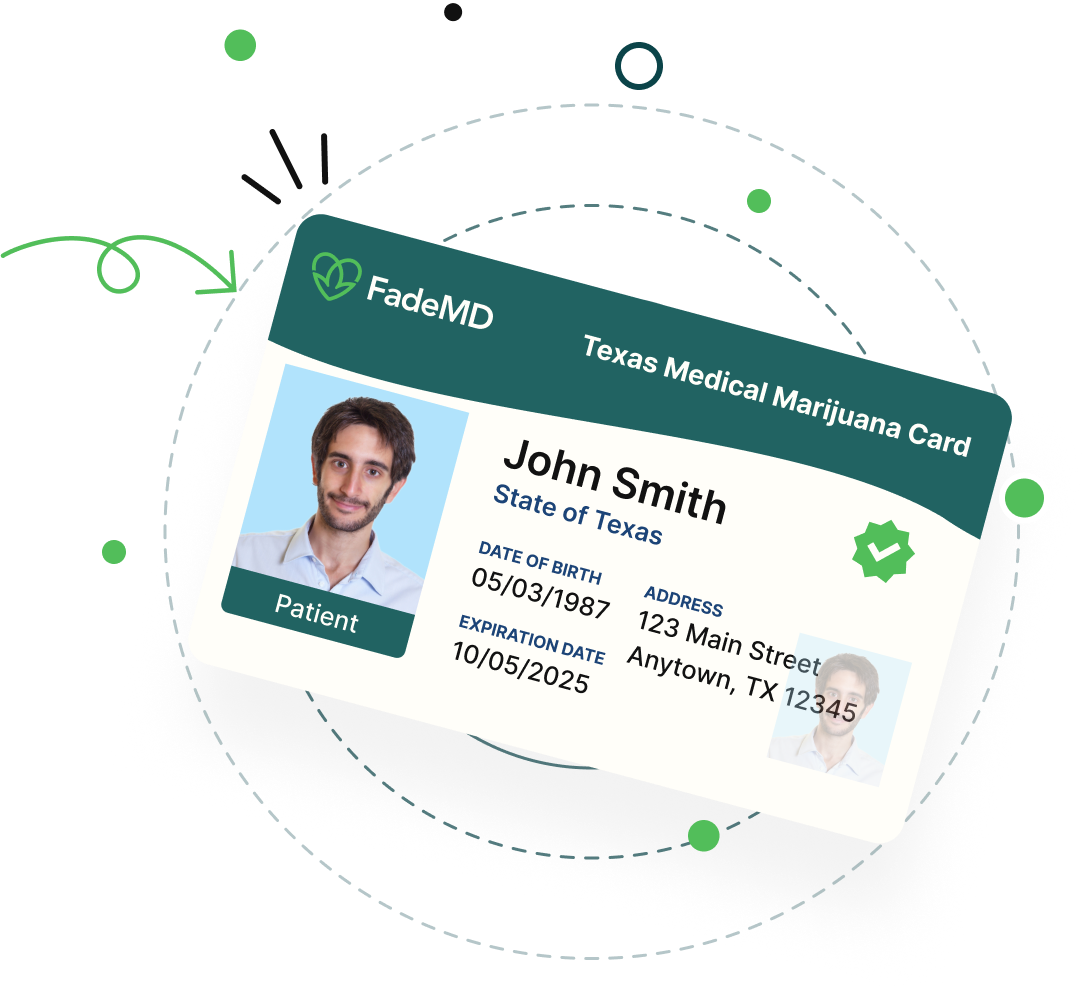



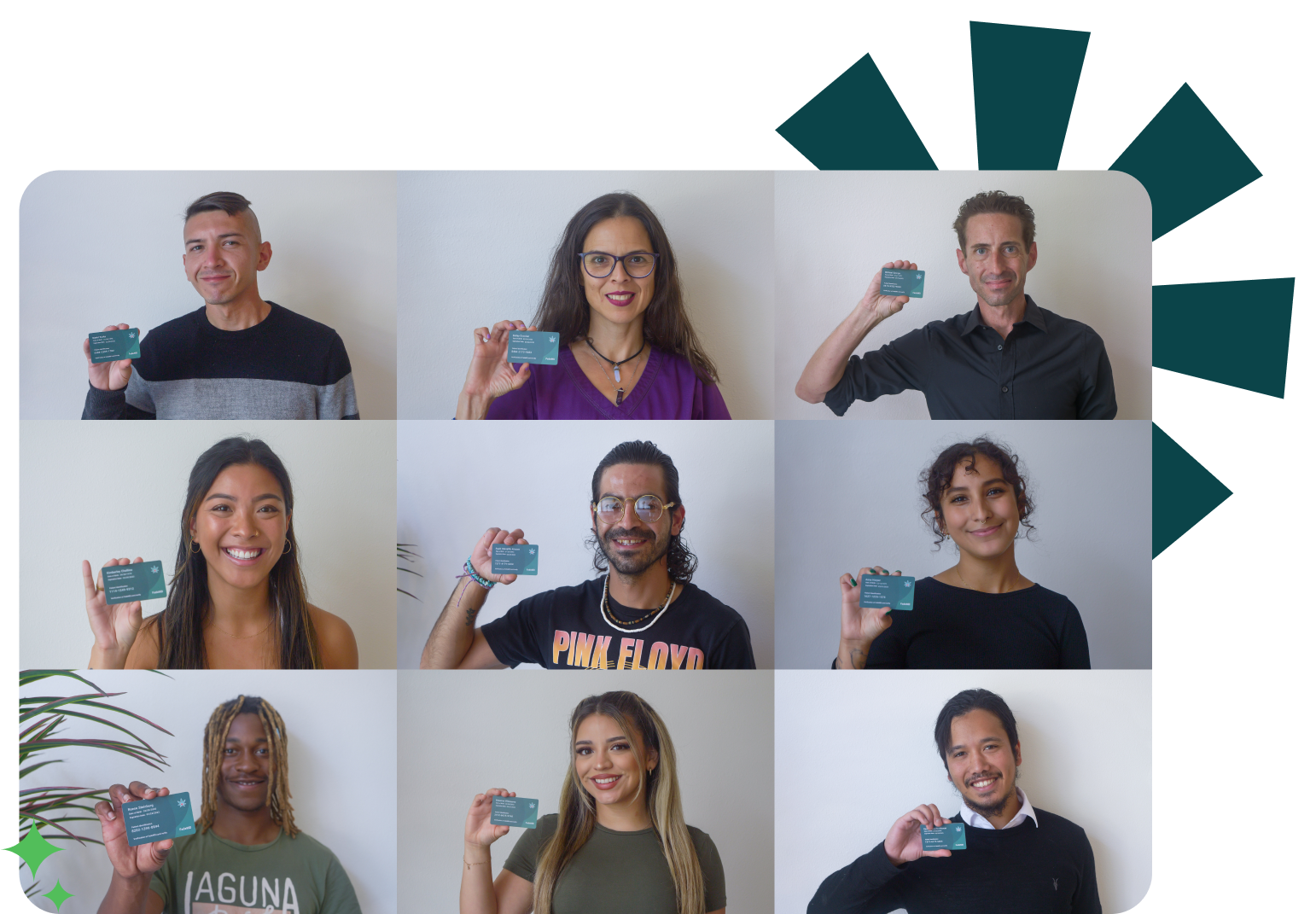
Trusted by 100,000+ patients around the USA









FadeMD simplifies the process of getting a medical marijuana card in your State. Register and speak with a medical professional today.

A licensed medical professionals will review your application and provide a cannabis consultation.

Upon approval, your medical professional will follow State guidelines to certify you for your medical marijuana card.

Receive full dispensary access, renewal reminders, and ongoing treatment options from your provider.


%201.svg)




Texas requires a medical marijuana card for dispensary access and cannabis consumption.

Medical users have access to better quality and higher strength products.

To visit a dispensary in Texas, you must have a medical marijuana card.

A medical marijuana card offers enhanced legal protections in Texas.


FadeMD is the leader in matching patients with medical marijuana professionals. Read patient experiences with FadeMD here.

Medical cannabis in Texas is available through the Texas Compassionate Use Program (CUP), created by the Texas Compassionate-Use Act (Senate Bill 339) signed in 2015.
Texas remains one of the more restrictive programs nationally. Smoking is not allowed under CUP, and “medical use” is defined as administration other than by smoking.
As of the latest update (House Bill 46, effective September 1, 2025), “low-THC cannabis” is defined as cannabis that contains no more than 10 milligrams of tetrahydrocannabinols per dosage unit.
Texas also sets package limits for dispensaries: a dispensing organization may not dispense low-THC cannabis in a package/container with more than 1 gram total tetrahydrocannabinols, and the same 1-gram cap applies to a pulmonary inhalation device.
Texas law also clarifies that “smoking” means burning/igniting and inhaling smoke, and it does not include inhaling something that is aerosolized/vaporized for pulmonary inhalation.
DSHS maintains the list of approved pulmonary inhalation devices (examples listed by DSHS include Jupiter Palm Pro and Jupiter M4B Pro as of 1/9/2026).
Important correction to your current draft: the “0.5% THC / 5% THC” language is outdated/inaccurate for today’s program. Texas moved from 0.5% to 1% by weight in 2021 (HB 1535), and later updated the definition to the current 10 mg per dosage unit standard (HB 46).
Under Texas State law, CUP is available to permanent Texas residents with a qualifying condition, when a CUP-registered physician determines the benefit outweighs the risk.
Note: “Anxiety” by itself is not on the statutory list of qualifying conditions.
Texas does not issue a traditional “medical marijuana card.” Instead, eligibility is handled through the Compassionate Use Registry of Texas (CURT) and verified by dispensaries.
Texas does not have a separate “caregiver card” process like many other states. In general:
Texas does not require patients to “renew a card” annually, and there is no state patient registration fee.
Instead, patients stay eligible by maintaining an active relationship with a qualified physician and receiving prescriptions/refills as clinically appropriate. Texas law now allows each prescription to provide a 90-day supply and up to four refills of a 90-day supply. To continue treatment, schedule a follow-up appointment so your physician can review your condition, adjust dosing if needed, and issue a new prescription or refills when appropriate
At the federal level, DOJ/DEA published a proposed rule in May 2024 to move marijuana from Schedule I to Schedule III, which began a formal rulemaking process.
DEA later issued notice of a hearing process, and the hearing scheduled for January 2025 was postponed pending appeal.
In December 2025, the White House issued an executive order focused on advancing medical marijuana/CBD research and directing agencies to proceed with the rescheduling process (but an executive order itself does not automatically change scheduling).
Separately from federal changes, Texas expanded CUP again in 2025 (HB 46) to add conditions like chronic pain, TBI, and Crohn’s/IBD, and updated dosing/package limits and pulmonary inhalation rules.


Our customer support team is on standby to help you out.