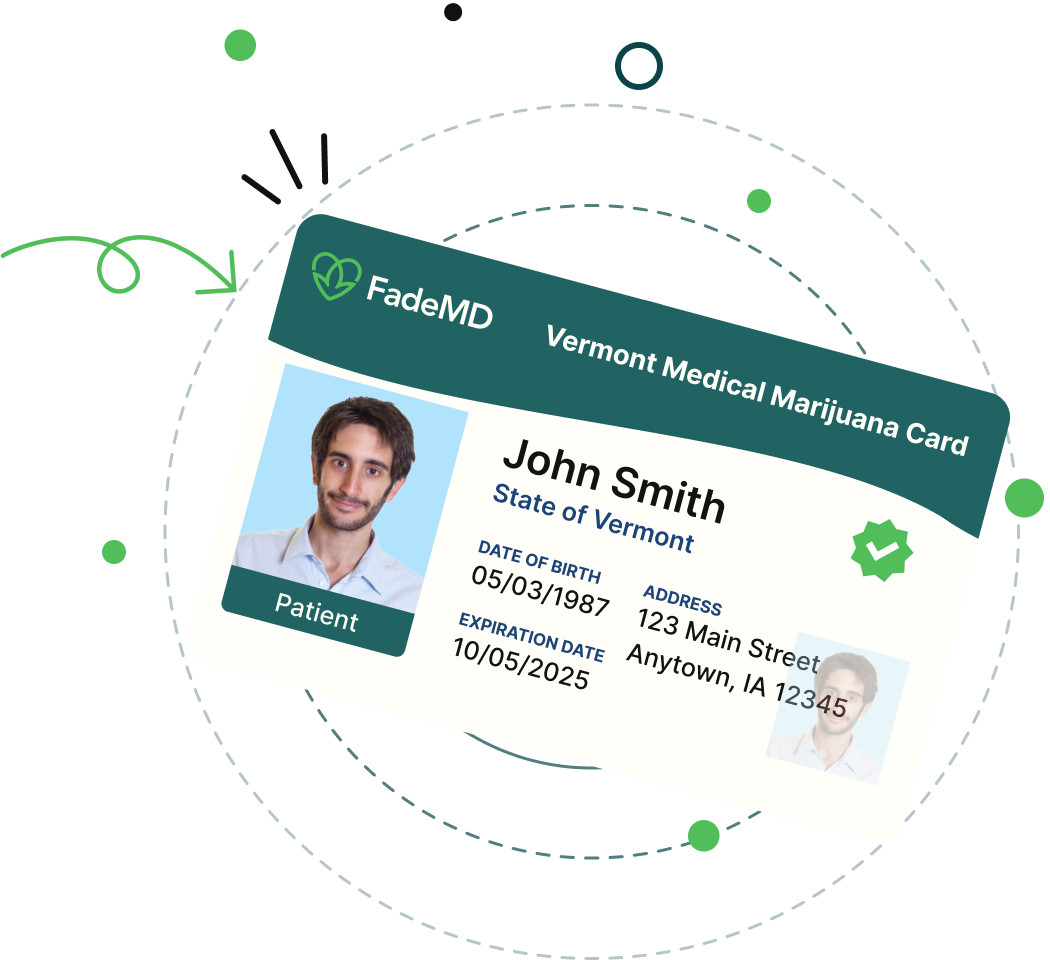



Trusted by 100,000+ patients around the USA









FadeMD simplifies the process of getting a medical marijuana card in your State. Register and speak with a medical professional today.

A licensed medical professionals will review your application and provide a cannabis consultation.

Upon approval, your medical professional will follow State guidelines to certify you for your medical marijuana card.

Receive full dispensary access, renewal reminders, and ongoing treatment options from your provider.


%201.svg)




Medical patients can be 18 years or older for dispensary access.

Medical users have access to better quality and higher strength products.

Save around 20% on medical marijuana taxes in Vermont.

A medical marijuana card offers enhanced legal protections in Vermont.


FadeMD is the leader in matching patients with medical marijuana professionals. Read patient experiences with FadeMD here.


In recent Vermont cannabis reform, HB 270 was passed by state legislators and heads to a congressional hearing. House Bill 270 increases the number of plants patients can cultivate at home, allowing for six mature and 12 immature plants.
The bill also increases the maximum allowable THC content in a single edible cannabis product from 50 to 100 mg, expands the list of qualifying conditions for medical cannabis treatment, increases the number of patients for whom a caregiver may provide services, and removes annual registration fees for qualifying caregivers.
Vermont became the ninth state to legalize recreational cannabis on January 22, 2018. The Vermont Legislature became the first in the US to legalize recreational marijuana without the use of a ballot initiative.
The Vermont Marijuana Registry (VMR) was established by the Department of Public Safety (DPS) to oversee the rules and regulations that govern the medical cannabis program. SB 76 sets out certain parameters used by the VMR for qualifying patients and caregivers to receive access to medical cannabis.
Only patients and caregivers in the registry, who have medical marijuana ID cards can purchase medical cannabis from VMR-licensed dispensaries. Patients may only obtain cannabis from their designated dispensary, and may only designate one (1) dispensary at a time. Patients may change their designated dispensary only once in a 90-day period. There are five (5) state-licensed dispensaries; a sixth may be added when the program includes more than 7,000 patients.
Patients in the registry are authorized to purchase and consume medical cannabis if they meet certain requirements for eligibility. To become a registered medical marijuana patient, a person must be diagnosed with a debilitating medical condition, and receive a recommendation by a health care professional in the course of an established healthcare professional-patient relationship.
Vermont has a short list of qualifying conditions for patients that, according to the Vermont Crime Information Center, “must be diagnosed with a qualifying debilitating medical condition” that include:
Along with having a qualifying condition, a patient must prove that they are a Vermont resident with a current driver’s license or state identification card. The approved patient must also pay a $50 annual non-refundable medical cannabis card registration fee.
First, schedule an evaluation with licensed physician through FadeMD. Complete a 10 minute consultation to get approved for medical cannabis use.
To finalize the patient registry application for the Vermont Marijuana Registry (VMR), you'll need to submit the application form along with a valid Vermont driver's license or identification card to verify residency. Additionally, include a digital, color photograph of yourself and specify a dispensary and caregivers, if applicable. For patients under 18, one registered adult caregiver is required, with an option to designate an additional caregiver.
If you plan to cultivate cannabis personally, provide the physical address and precise location of the enclosed facility. Keep in mind that registered patients cannot cultivate cannabis if they designate a dispensary.
Additionally, include a Qualifying Condition Verification Form completed by a healthcare professional. This form should demonstrate a genuine healthcare professional-patient relationship or indicate recent onset of the debilitating medical condition, along with verification from a healthcare professional.
Finally, you must pay a $50 non-refundable fee for the registry identification card.
A designated caregiver assisting a state-registered medical cannabis patient must be at least 21 years old. Additionally, the caregiver needs to undergo a criminal background check and verify Vermont residency by presenting a valid driver’s license or state identification card.
To renew your Vermont medical marijuana card with FadeMD, simply schedule a renewal appointment with one of our physicians. They will assess your ongoing need for medical cannabis and guide you through the renewal process. We'll remind you when your renewal is due, or feel free to contact our Customer Service Department for assistance and to apply any available renewal discounts.
A medical marijuana card in Vermont is valid for either one or three years, depending on your condition.
In Vermont, patients or caregivers can possess up to two ounces of cannabis flower or two mature plants and seven immature shrubs. Patients must designate a specific dispensary for cannabis purchases, and cultivation is permitted on private property, provided it's not visible to the public. Dispensaries also sell clones and seeds for growing cannabis.
The Justice Department proposed a new rule to reclassify marijuana as a Schedule III drug, which would ease federal restrictions on cannabis if approved. This reclassification would not legalize or decriminalize marijuana nationwide but would place it on the same regulatory level as ketamine and anabolic steroids. Currently, marijuana is classified as a Schedule I drug, meaning it has "no currently accepted medical use and a high potential for abuse." The proposed change would recognize marijuana as having "a moderate to low potential for physical and psychological dependence."
The proposal initiates a months-long comment and administrative period before any changes take effect. This follows President Biden's 2022 request for the Department of Health and Human Services (HHS) and the Justice Department to review marijuana's classification. HHS found credible scientific evidence supporting marijuana's medical use. The notice of proposed rulemaking reflects the attorney general's agreement with HHS's recommendation. President Biden hailed the move as "monumental," emphasizing marijuana policy as a priority of his administration, which has also worked to pardon those convicted of simple possession.


Our customer support team is on standby to help you out.